А можно по-русски?
Saturday, 21 November 2009
Note
I facilitated a seminar on HIV/AIDS in school for 14 y.o. youngsters. It felt like they were 20 instead of 10.

Wednesday, 14 October 2009
"AIDS in my eyes"
Retrospective 3. May again.
For two days I had a wonderful opportunity to visit the town of Homel. The final event of the project "AIDS in my eyes" - a round table, gathering representatives of closed educational facilities of Homel region - was to be held there. The project was implemented by Fialta's partner organization "New Faces". The fialtians in this project were trainers in HIV/AIDS.
What was my job? Well someone has to play with the kids while grownups discuss the project...
Homel turned out to be a very green and open city:
The event itself consisted of an exposition with drawings on the HIV/AIDS topic:


And the round table itself:

So basically the trainings were done, kids educated, and further partnership discussed.
I got to see Homel and meet a local rock-band "Wind".

For two days I had a wonderful opportunity to visit the town of Homel. The final event of the project "AIDS in my eyes" - a round table, gathering representatives of closed educational facilities of Homel region - was to be held there. The project was implemented by Fialta's partner organization "New Faces". The fialtians in this project were trainers in HIV/AIDS.
What was my job? Well someone has to play with the kids while grownups discuss the project...
Homel turned out to be a very green and open city:
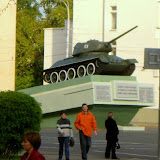 |
| Homel - Landmarks |
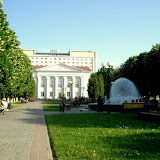 |
| Homel - Streets |
The event itself consisted of an exposition with drawings on the HIV/AIDS topic:
And the round table itself:
So basically the trainings were done, kids educated, and further partnership discussed.
I got to see Homel and meet a local rock-band "Wind".
Friday, 9 October 2009
Блакітныя Азёры (The Blue Lakes)
Retrospective, episode 2. Still in May.
This story set off with a swiss Andy, whom I met on the study visit. And a guide.
There's a guide - Lonely Planet - with advice for travelers to different parts of the world. So Andreas, a traveler with experience, came to Belarus with this exact guide, which contained 2 sentences about Blue Lakes. 2 whole sentences.
So, after 6 days of the study visit, he rented a car and set off, taking with him Sophie from France and Sania from Latvia.

The puzzling fact is that these lakes, a jewel of Belarus landmarks, a marvelous product of mother nature's doings, is not marked on any maps. We had to improvise. Asked a few friends, got a direction and set off. To Miadzieł.

On the way a water basin caught our attention.


Miadzieł is a sweet little city near Naroch. Of course it has its own Lenin...

... a stage...

... and a castle! As we found out from man informational billboard. So there went. To the castle.

Coming up to a lake, we almost decided we got lost.

However, a passing fisherman dissolved our fears, with a wide gesture showing us the "castle".

As we were quietly endorsing the development of belarusian rural p.r., the man added:
-If you walk a bit further, there's also a beach.
We didn't bother to explore "the beach" and headed north.


We discovered the way via a couple of construction workers, gifted a piece of swiss chocolate with pistachios to a citizen of Konstantinovo (to fight his alcohol breath) and finally made it to Grumbinenty. Don't bother looking at the map. It's not there.

The owner of this, and a handful of other artworks-out-of-anything, made it clear, that it wasn't possible to get closer than 2km to the lakes by car. So we walked.

Describing what we say has little sense, have a look for yourself. We passed Glubelka, Glubla and Mertvoe.
The place is very clean, ready for tourists. Just that it's all in russian.
The entrance turned out to be on the opposite side of the area, but we didn't have the day to see all of the place. We saw what we could and set out back on P95.

The road back was no less scenic.


Tired of the road we had dinner in Smorgon. The cuisine was twice cheaper than in the capital.


And on to Minsk, without incident.


That's it, thank you for your attention.
This story set off with a swiss Andy, whom I met on the study visit. And a guide.
There's a guide - Lonely Planet - with advice for travelers to different parts of the world. So Andreas, a traveler with experience, came to Belarus with this exact guide, which contained 2 sentences about Blue Lakes. 2 whole sentences.
So, after 6 days of the study visit, he rented a car and set off, taking with him Sophie from France and Sania from Latvia.
The puzzling fact is that these lakes, a jewel of Belarus landmarks, a marvelous product of mother nature's doings, is not marked on any maps. We had to improvise. Asked a few friends, got a direction and set off. To Miadzieł.
On the way a water basin caught our attention.
Miadzieł is a sweet little city near Naroch. Of course it has its own Lenin...
... a stage...
... and a castle! As we found out from man informational billboard. So there went. To the castle.
Coming up to a lake, we almost decided we got lost.
However, a passing fisherman dissolved our fears, with a wide gesture showing us the "castle".
As we were quietly endorsing the development of belarusian rural p.r., the man added:
-If you walk a bit further, there's also a beach.
We didn't bother to explore "the beach" and headed north.
We discovered the way via a couple of construction workers, gifted a piece of swiss chocolate with pistachios to a citizen of Konstantinovo (to fight his alcohol breath) and finally made it to Grumbinenty. Don't bother looking at the map. It's not there.
The owner of this, and a handful of other artworks-out-of-anything, made it clear, that it wasn't possible to get closer than 2km to the lakes by car. So we walked.
Describing what we say has little sense, have a look for yourself. We passed Glubelka, Glubla and Mertvoe.
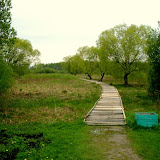 |
| Belarus - Travel |
The place is very clean, ready for tourists. Just that it's all in russian.
The entrance turned out to be on the opposite side of the area, but we didn't have the day to see all of the place. We saw what we could and set out back on P95.
The road back was no less scenic.
Tired of the road we had dinner in Smorgon. The cuisine was twice cheaper than in the capital.
And on to Minsk, without incident.
That's it, thank you for your attention.
Thursday, 8 October 2009
Youthwork Realities in Belarus
Retrospective, episode 1. Remembering May...
As you know, my trip home didn't do my studies any good. I wasn't reinstated and I didn't finish the thesis. But on my return I was awaited by something, to my mind, grand. A study visit to Belarus from EU in the framework of "Youth in Action" program.
To my knowledge this event - "Youthwork realities in Belarus" - was in preparation for a long time. Reaching agreements with SALTO and local authorities... But it really happened - youth workers from EU, representatives of european NGOs, EU governmental structures and structures of "Youth in Action" for 5 days could enjoy to the fullest that, which I see every day.
This event gathered participants from Poland, Belgium, France, Lithuania, Denmark, Austria, Portugal, Switzerland, Great Britain... It was pretty much all of EU.
5.05.09
Day 1
The program was pretty intense. The first day was dedicated to arrivals, hotel check-ins and getting to know each other

6.05.09
Day 2
The second day started with a visit to Department of Youth Affairs. To my mind, the view of 30 foreigners going up the square by the House of Officers is already a magnificent sight.

At the round table with synchronized translation participants had the opportunity to hear the department's representatives and ask questions.

Second part of the day was devoted to meetings with NGOs of Minsk, who also could present their activities and answer questions.

The evening was an intercultural dinner, open to guests from different organizations, where participants and social activists of Minsk could socialize in non-formal atmosphere.
7.05.09
Day 3
The next day delegations set out to visit Hospice, SOS-kinderdorf and other organizations active in work with children and youth.


8.05.09
Day 4
Was a trip to Hrodno, meeting with local activists and relaxation with non-formal communication.

9.05.09
Day 5
Summing up.

CDs with photos.

Free day and a dinner together.

And going home.
From my side I can say this was an out of the ordinary event, which gave a real opportunity for NGO-workers from Belarus and EU to communicate and get to know at least something about each other. Whether it will bear fruit only time will tell, but I'm glad I could be a part of this.
As you know, my trip home didn't do my studies any good. I wasn't reinstated and I didn't finish the thesis. But on my return I was awaited by something, to my mind, grand. A study visit to Belarus from EU in the framework of "Youth in Action" program.
To my knowledge this event - "Youthwork realities in Belarus" - was in preparation for a long time. Reaching agreements with SALTO and local authorities... But it really happened - youth workers from EU, representatives of european NGOs, EU governmental structures and structures of "Youth in Action" for 5 days could enjoy to the fullest that, which I see every day.
This event gathered participants from Poland, Belgium, France, Lithuania, Denmark, Austria, Portugal, Switzerland, Great Britain... It was pretty much all of EU.
5.05.09
Day 1
The program was pretty intense. The first day was dedicated to arrivals, hotel check-ins and getting to know each other
6.05.09
Day 2
The second day started with a visit to Department of Youth Affairs. To my mind, the view of 30 foreigners going up the square by the House of Officers is already a magnificent sight.
At the round table with synchronized translation participants had the opportunity to hear the department's representatives and ask questions.
Second part of the day was devoted to meetings with NGOs of Minsk, who also could present their activities and answer questions.
The evening was an intercultural dinner, open to guests from different organizations, where participants and social activists of Minsk could socialize in non-formal atmosphere.
7.05.09
Day 3
The next day delegations set out to visit Hospice, SOS-kinderdorf and other organizations active in work with children and youth.
8.05.09
Day 4
Was a trip to Hrodno, meeting with local activists and relaxation with non-formal communication.
9.05.09
Day 5
Summing up.
CDs with photos.
Free day and a dinner together.
And going home.
From my side I can say this was an out of the ordinary event, which gave a real opportunity for NGO-workers from Belarus and EU to communicate and get to know at least something about each other. Whether it will bear fruit only time will tell, but I'm glad I could be a part of this.
Wednesday, 7 October 2009
New season
So I've spent the whole summer busy with events and all of September getting my photos recycled. In a short while I'll catch up on the informational part. So coming soon...
...and much more.
Meanwhile have a look at the updated photo album.
- Study visit of EU youth workers to Belarus
- Outdoor camp with people with disabilities
- Guides' camp on the Braslav lakes
- Summer university of UNESCO clubs
...and much more.
Meanwhile have a look at the updated photo album.
Sunday, 17 May 2009
Of culture
There's a puzzling term in 8 key competences - the base of a large part of non-formal education theory - called Cultural expression. Also they speak of Sense of belonging in context of, for instance, active or european citizenship. I didn't give weight and couldn't understand for a long time what these interesting people are talking about.
And it was worth it - leave home for 3 months just to get to know myself.
I've never given a lot of worth to my personal culture. I even had doubts it existed - I'm simply russian, just in Latvia. I started having some questions when I was in Russia for the first time. Why don't we understand each other? How can they tell who's local and who's not?
I also got something from a week-long russian-speaking camp in Saints-Petersburg. I was mistaken for a local a few times, but I had someone to compare to - representatives of Russia, Ukraine, Belarus and russian-speaking minorities of the Baltic states. It was a wide specter of slavs, actually. And it was marvelous experience as I realize now.
I am a part of a small, on a world's scale, part of society - russian-speakers of Latvia. To foreigners I'm totally russian. To russians I'm totally european. What am I then?
I listen to Brainstorm / Prāta vētra in 3 languages, but I especially love them in latvian, because the lyrics are more sincere;
I don't understand blat and vodka;
I speak milder russian, but I don't pronounce latvian long-vowel nuances;
I jump in joy at the sight of signboard in russian in any country of CIS and I use metro even if I need to go just one bus stop;
I drink estonian liqueur and swear in lithuanian because latvian doesn't have swear words (neither does lithuanian, but that doesn't matter much);
Anyway, you can see all of those things. But the feeling you can't see. I want to speak latvian, I want to listen to and let others hear Prāta Vētra, I want to tell stories about small streets of Old Riga and about cape Kolka, which I visited just twice. I want to go to my shallow sea, which is really a gulf, but that fact doesn't matter!
I make jokes about my proud pigmy-sized kingdom and love it dearly.
I'm not russian living in Latvia. I come from Latvia.
And it was worth it - leave home for 3 months just to get to know myself.
I've never given a lot of worth to my personal culture. I even had doubts it existed - I'm simply russian, just in Latvia. I started having some questions when I was in Russia for the first time. Why don't we understand each other? How can they tell who's local and who's not?
I also got something from a week-long russian-speaking camp in Saints-Petersburg. I was mistaken for a local a few times, but I had someone to compare to - representatives of Russia, Ukraine, Belarus and russian-speaking minorities of the Baltic states. It was a wide specter of slavs, actually. And it was marvelous experience as I realize now.
I am a part of a small, on a world's scale, part of society - russian-speakers of Latvia. To foreigners I'm totally russian. To russians I'm totally european. What am I then?
I listen to Brainstorm / Prāta vētra in 3 languages, but I especially love them in latvian, because the lyrics are more sincere;
I don't understand blat and vodka;
I speak milder russian, but I don't pronounce latvian long-vowel nuances;
I jump in joy at the sight of signboard in russian in any country of CIS and I use metro even if I need to go just one bus stop;
I drink estonian liqueur and swear in lithuanian because latvian doesn't have swear words (neither does lithuanian, but that doesn't matter much);
Anyway, you can see all of those things. But the feeling you can't see. I want to speak latvian, I want to listen to and let others hear Prāta Vētra, I want to tell stories about small streets of Old Riga and about cape Kolka, which I visited just twice. I want to go to my shallow sea, which is really a gulf, but that fact doesn't matter!
I make jokes about my proud pigmy-sized kingdom and love it dearly.
I'm not russian living in Latvia. I come from Latvia.
Sunday, 3 May 2009
Holidays
Spent a week in Latvia. Had 2 reasons - get a new visa and work on my university. Also got a lucky chance to participate in an exchange evaluation seminar from National Agency of Latvia. Got an impression that Latvia still has small experience in youth exchanges and Non-formal Education. Can't wait to return for good and get to work...
All in all my visa was ready in a day. Looks like a letter from Minsk City Executive Committee cancels all kinds of bureaucracy and stalls. Now I have 90 days during a year to get a temporary living permission. My EVS still counts 9 months.
My university didn't work out that well. I finished the theoretical part of my thesis, but I'll have to write the practical part in Belarus. Didn't write an application to reinstate also. If I don't get it till end of May... There's always next year. :)
It's interesting that in a week I got more calls from friends than in previous half a year. Turns out I've got a lot of them.
Experienced mentors advise not to stall home if the project is not over. So I got some summer clothes, 2 cans of home-made pickles and I'm going back.
All in all my visa was ready in a day. Looks like a letter from Minsk City Executive Committee cancels all kinds of bureaucracy and stalls. Now I have 90 days during a year to get a temporary living permission. My EVS still counts 9 months.
My university didn't work out that well. I finished the theoretical part of my thesis, but I'll have to write the practical part in Belarus. Didn't write an application to reinstate also. If I don't get it till end of May... There's always next year. :)
It's interesting that in a week I got more calls from friends than in previous half a year. Turns out I've got a lot of them.
Experienced mentors advise not to stall home if the project is not over. So I got some summer clothes, 2 cans of home-made pickles and I'm going back.
Sunday, 19 April 2009
In the field
First experience was interesting and fruitful. In pair with an experienced trainer we facilitated an activity on HIV/AIDS for 16 y.o. to-be-construction-workers. As it seemed there's no discipline whatsoever, laughs and jokes all the way, but the youngsters got interested. Altogether I'm pleased.
I've got to be a little faster - I'm calmly laying out the material, whereas the guys are young, with boiling blood, ready to act. That's where I keep losing them.
Well, going to work on. Just need to go home, get a new visa, help to organize a study visit from EU to Belarus...
I've got to be a little faster - I'm calmly laying out the material, whereas the guys are young, with boiling blood, ready to act. That's where I keep losing them.
Well, going to work on. Just need to go home, get a new visa, help to organize a study visit from EU to Belarus...
Wednesday, 15 April 2009
Fact
There's two of us. Didn't know that because his/her project was accepted in the Commission.
Sunday, 12 April 2009
STDs and other adventures
Fialta did a big job in the sphere of youth reproductive health. Non-formal seminars on sexually transmitted diseases and drug abuse are still popular, though the last project ended about a year ago. Schools are calling, asking to facilitate.
One-and-a-half hours long seminars are good not just to pass the information to participants, but they also make a great school for the facilitators. The theme is practical enough, but the circumstances tend to be stressful - school classes, pre-formed group, questionable organization and so on. Quite the excitement, I reckon. I can't wait! >:)
Last Sunday I passed a light 4-hour training on STDs with volunteer camp leaders. Usually facilitators for Fialta's seminars are being prepared via 2-day training courses, but they made an exception for me. I think I'll get the hang of it, I'm not a total newbie. On Monday I'll get an improvised test and on Friday I have first field experience. Not nervous, but I consider this kind of important.
* * *
Intercultural learning is working in strange ways. The fact that I speak great Russian is making most of the people confused about how deep I am in the context, about what I understand and mostly they consider that I don't need any extra help or information. This leads to two interesting moments:
1. there are many things everyone knows, but I don't. So I have to ask and insist on explanations.
2. when going deeper into some theme I see that my theory and experience differs from common. Sometimes I can offer another point of view, but I have to overcome the "current".
So basically, on the Johari window I'm walking from "blind" to "hidden".
Guess were I speaking latvian, environment would react differently, would be more obsessive and explain a lot. On the other hand I wouldn't fit in this quick. But this feeling, when you think you know what to do and how, but in practice it turns out you lose something completely primitive were you in the context. *Sigh* :)
One-and-a-half hours long seminars are good not just to pass the information to participants, but they also make a great school for the facilitators. The theme is practical enough, but the circumstances tend to be stressful - school classes, pre-formed group, questionable organization and so on. Quite the excitement, I reckon. I can't wait! >:)
Last Sunday I passed a light 4-hour training on STDs with volunteer camp leaders. Usually facilitators for Fialta's seminars are being prepared via 2-day training courses, but they made an exception for me. I think I'll get the hang of it, I'm not a total newbie. On Monday I'll get an improvised test and on Friday I have first field experience. Not nervous, but I consider this kind of important.
* * *
Intercultural learning is working in strange ways. The fact that I speak great Russian is making most of the people confused about how deep I am in the context, about what I understand and mostly they consider that I don't need any extra help or information. This leads to two interesting moments:
1. there are many things everyone knows, but I don't. So I have to ask and insist on explanations.
2. when going deeper into some theme I see that my theory and experience differs from common. Sometimes I can offer another point of view, but I have to overcome the "current".
So basically, on the Johari window I'm walking from "blind" to "hidden".
 |
Guess were I speaking latvian, environment would react differently, would be more obsessive and explain a lot. On the other hand I wouldn't fit in this quick. But this feeling, when you think you know what to do and how, but in practice it turns out you lose something completely primitive were you in the context. *Sigh* :)
Saturday, 4 April 2009
In Hrodna
But my visit to Hrodna turned out to be nothing like a business trip.
For the time of the training course I managed to visit a disco, get very little sleep, get a personal excursion of Hrodna, get to know the organizational culture of the "Third Sector" a little (very pleasant young journalists), try real blackberry jam and hitchhike to Minsk.
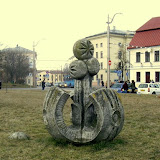 |
| Hrodna - Landmarks |
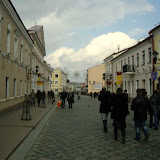 |
| Hrodna - Streets |
For the time of the training course I managed to visit a disco, get very little sleep, get a personal excursion of Hrodna, get to know the organizational culture of the "Third Sector" a little (very pleasant young journalists), try real blackberry jam and hitchhike to Minsk.
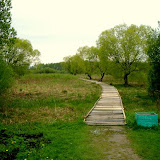 |
| Travel |
Friday, 3 April 2009
School of educators
I spent the weekend in Hrodna at a training for leaders of educational circles, organized by the Organization of Civil Education.
They have an idea to integrate an interesting form of non-formal education for adults - educational circles. This form was borrowed from Sweden, where these circles are popular. The idea is to research a certain theme over a number of meetings (5-15 about 3 hours each) in a direction the group is interested in. The group is up to 12 participants, from which everyone is making an input to the learning process. And all this based on the principles of non-formal education.
The training was the first part of a large project. It was just to investigate the concept of the circle. Next we'll have a thematic seminar (6 different themes in different cities across Belarus) and a methodological, after which we'll be able to organize our own learning circle.
I can't really say how effective this form is in this concrete context. Guess time will tell.
They have an idea to integrate an interesting form of non-formal education for adults - educational circles. This form was borrowed from Sweden, where these circles are popular. The idea is to research a certain theme over a number of meetings (5-15 about 3 hours each) in a direction the group is interested in. The group is up to 12 participants, from which everyone is making an input to the learning process. And all this based on the principles of non-formal education.
The training was the first part of a large project. It was just to investigate the concept of the circle. Next we'll have a thematic seminar (6 different themes in different cities across Belarus) and a methodological, after which we'll be able to organize our own learning circle.
I can't really say how effective this form is in this concrete context. Guess time will tell.
Wednesday, 25 March 2009
A word on the photos
Before my departure from Latvia my dad gave me his camera. Which came kind of handy - I stuck to a schedule of 3 photos a day for a month. And I don't think I'm still behind it.
My photos, after some tweaking and editing, make it to the internet. I use Picasa Web Albums as a host and divide my photos in a few main albums, which I update on a regular basis.
Captions mainly in russian, sorry (untranslatable play on words, some realities, which I can't find a synonym to and so on).
Here they are:
My impressions collected all over Belarus. Things which mean something to me personally (and often only to me personally).
From my apartment in Belrad - an institute of radiation protection.
Things I find funny, peculiar or just plain interesting for the major public.
More usual things I see in the streets.
Photos of famous sites, monuments or other objects of historical or cultural value.
Photos connected with my hosting organization Fialta.
Photos from my travels in Belarus. Yet to come. ;)
Occasionally I make albums dedicated to a single event, like Zubrenok or Minsk Boulderfest, which are available in my public photos.
My photos, after some tweaking and editing, make it to the internet. I use Picasa Web Albums as a host and divide my photos in a few main albums, which I update on a regular basis.
Captions mainly in russian, sorry (untranslatable play on words, some realities, which I can't find a synonym to and so on).
Here they are:
 |
| Belarus - Impressions |
 |
| Belrad |
 |
| Peculiar |
 |
| Minsk - Streets |
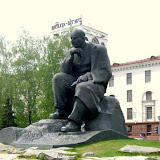 |
| Minsk - Landmarks |
 |
| Fialta |
 |
| Belarus - Travel |
Occasionally I make albums dedicated to a single event, like Zubrenok or Minsk Boulderfest, which are available in my public photos.

 Posts
Posts