А можно по-русски?
First experience was interesting and fruitful. In pair with an experienced trainer we facilitated an activity on HIV/AIDS for 16 y.o. to-be-construction-workers. As it seemed there's no discipline whatsoever, laughs and jokes all the way, but the youngsters got interested. Altogether I'm pleased.
I've got to be a little faster - I'm calmly laying out the material, whereas the guys are young, with boiling blood, ready to act. That's where I keep losing them.
Well, going to work on. Just need to go home, get a new visa, help to organize a study visit from EU to Belarus...
Sunday, 19 April 2009

Wednesday, 15 April 2009
Fact
There's two of us. Didn't know that because his/her project was accepted in the Commission.
Sunday, 12 April 2009
STDs and other adventures
Fialta did a big job in the sphere of youth reproductive health. Non-formal seminars on sexually transmitted diseases and drug abuse are still popular, though the last project ended about a year ago. Schools are calling, asking to facilitate.
One-and-a-half hours long seminars are good not just to pass the information to participants, but they also make a great school for the facilitators. The theme is practical enough, but the circumstances tend to be stressful - school classes, pre-formed group, questionable organization and so on. Quite the excitement, I reckon. I can't wait! >:)
Last Sunday I passed a light 4-hour training on STDs with volunteer camp leaders. Usually facilitators for Fialta's seminars are being prepared via 2-day training courses, but they made an exception for me. I think I'll get the hang of it, I'm not a total newbie. On Monday I'll get an improvised test and on Friday I have first field experience. Not nervous, but I consider this kind of important.
* * *
Intercultural learning is working in strange ways. The fact that I speak great Russian is making most of the people confused about how deep I am in the context, about what I understand and mostly they consider that I don't need any extra help or information. This leads to two interesting moments:
1. there are many things everyone knows, but I don't. So I have to ask and insist on explanations.
2. when going deeper into some theme I see that my theory and experience differs from common. Sometimes I can offer another point of view, but I have to overcome the "current".
So basically, on the Johari window I'm walking from "blind" to "hidden".
Guess were I speaking latvian, environment would react differently, would be more obsessive and explain a lot. On the other hand I wouldn't fit in this quick. But this feeling, when you think you know what to do and how, but in practice it turns out you lose something completely primitive were you in the context. *Sigh* :)
One-and-a-half hours long seminars are good not just to pass the information to participants, but they also make a great school for the facilitators. The theme is practical enough, but the circumstances tend to be stressful - school classes, pre-formed group, questionable organization and so on. Quite the excitement, I reckon. I can't wait! >:)
Last Sunday I passed a light 4-hour training on STDs with volunteer camp leaders. Usually facilitators for Fialta's seminars are being prepared via 2-day training courses, but they made an exception for me. I think I'll get the hang of it, I'm not a total newbie. On Monday I'll get an improvised test and on Friday I have first field experience. Not nervous, but I consider this kind of important.
* * *
Intercultural learning is working in strange ways. The fact that I speak great Russian is making most of the people confused about how deep I am in the context, about what I understand and mostly they consider that I don't need any extra help or information. This leads to two interesting moments:
1. there are many things everyone knows, but I don't. So I have to ask and insist on explanations.
2. when going deeper into some theme I see that my theory and experience differs from common. Sometimes I can offer another point of view, but I have to overcome the "current".
So basically, on the Johari window I'm walking from "blind" to "hidden".
 |
Guess were I speaking latvian, environment would react differently, would be more obsessive and explain a lot. On the other hand I wouldn't fit in this quick. But this feeling, when you think you know what to do and how, but in practice it turns out you lose something completely primitive were you in the context. *Sigh* :)
Saturday, 4 April 2009
In Hrodna
But my visit to Hrodna turned out to be nothing like a business trip.
For the time of the training course I managed to visit a disco, get very little sleep, get a personal excursion of Hrodna, get to know the organizational culture of the "Third Sector" a little (very pleasant young journalists), try real blackberry jam and hitchhike to Minsk.
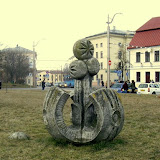 |
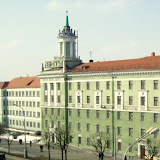
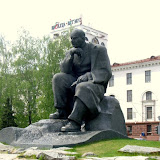
| Hrodna - Landmarks |
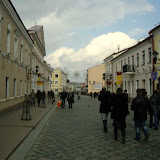 |
| Hrodna - Streets |
For the time of the training course I managed to visit a disco, get very little sleep, get a personal excursion of Hrodna, get to know the organizational culture of the "Third Sector" a little (very pleasant young journalists), try real blackberry jam and hitchhike to Minsk.
 |
| Travel |
Friday, 3 April 2009
School of educators
I spent the weekend in Hrodna at a training for leaders of educational circles, organized by the Organization of Civil Education.
They have an idea to integrate an interesting form of non-formal education for adults - educational circles. This form was borrowed from Sweden, where these circles are popular. The idea is to research a certain theme over a number of meetings (5-15 about 3 hours each) in a direction the group is interested in. The group is up to 12 participants, from which everyone is making an input to the learning process. And all this based on the principles of non-formal education.
The training was the first part of a large project. It was just to investigate the concept of the circle. Next we'll have a thematic seminar (6 different themes in different cities across Belarus) and a methodological, after which we'll be able to organize our own learning circle.
I can't really say how effective this form is in this concrete context. Guess time will tell.
They have an idea to integrate an interesting form of non-formal education for adults - educational circles. This form was borrowed from Sweden, where these circles are popular. The idea is to research a certain theme over a number of meetings (5-15 about 3 hours each) in a direction the group is interested in. The group is up to 12 participants, from which everyone is making an input to the learning process. And all this based on the principles of non-formal education.
The training was the first part of a large project. It was just to investigate the concept of the circle. Next we'll have a thematic seminar (6 different themes in different cities across Belarus) and a methodological, after which we'll be able to organize our own learning circle.
I can't really say how effective this form is in this concrete context. Guess time will tell.

 Posts
Posts